Understanding Diaeresis Umlaut Differences in Text
Understand diaeresis umlaut differences through French, German and Spanish examples, and see why Unicode can encode both functions identically.
Distinguishing diaeresis from umlaut, which appear identical on screen but serve different functions. In French, the diaeresis is used to separate vowel sounds like o and e (e.g., Noël), while the umlaut is a change in vowel sound, as in German Hand → Hände. The diaeresis marks vowels that are pronounced independently of a usual digraph or diphthong, such as the two vowels in naïve, while an umlaut changes the vowel sound itself, as in the singular-to-plural shift of Hant → Henti. The appearance alone is not sufficient to identify the mark; the context in which it appears determines whether it functions as a diaeresis or an umlaut.
Diaeresis in Spanish
The Spanish exception demonstrates how a diaeresis signals an audible vowel, such as in güe or güi. While other languages use a diaeresis to indicate a separate syllable, Spanish uses the diaeresis to distinguish between an audible vowel and one that’s part of the word’s structure. For example, the Spanish word cigüeña contains a ü with an audible u, even though there isn’t a separate u syllable. Similarly, pingüino [piŋˈɡwino] contains a [gw] with an audible u pronounced as [w], without a separate u syllable.
In Unicode, the character ö represents both the o-umlaut and o-diaeresis, but its official name is LATIN SMALL LETTER O WITH DIAERESIS. The character’s official name does not distinguish these linguistic functions; the language and word context determine whether the mark serves as a diaeresis or an umlaut.
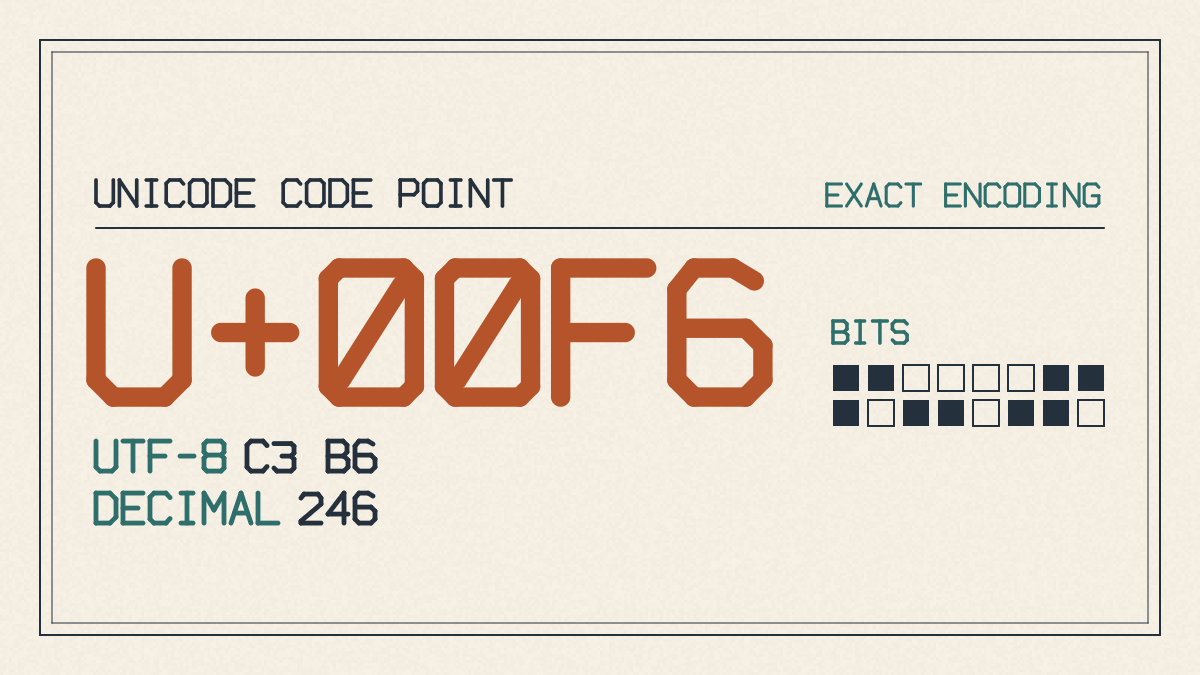
While many people know how to copy a complete precomposed vowel, such as ö, they may not know about the base-plus-mark representation. For example, you can directly copy the German letter ö by using the Unicode value for this character, U+00F6. But you can also construct this same glyph from scratch using the base letter o (U+006F) followed by the combining mark, U+0308 COMBINING DIAERESIS. The latter approach involves knowing what each individual element means, which might be difficult at first glance. U+0308 is a nonspacing combining mark, also known as umlaut, rather than a complete vowel letter on its own.