Vertical Ellipsis Symbol ⋮ (U+22EE): Copy, Codes, and Meaning
Copy the vertical ellipsis symbol ⋮ and learn its Unicode name U+22EE, Alt/HTML/CSS codes, math uses, and differences from other three-dot symbols.
The vertical ellipsis is not three stacked periods.
It’s a single Unicode character: Vertical Ellipsis, U+22EE.
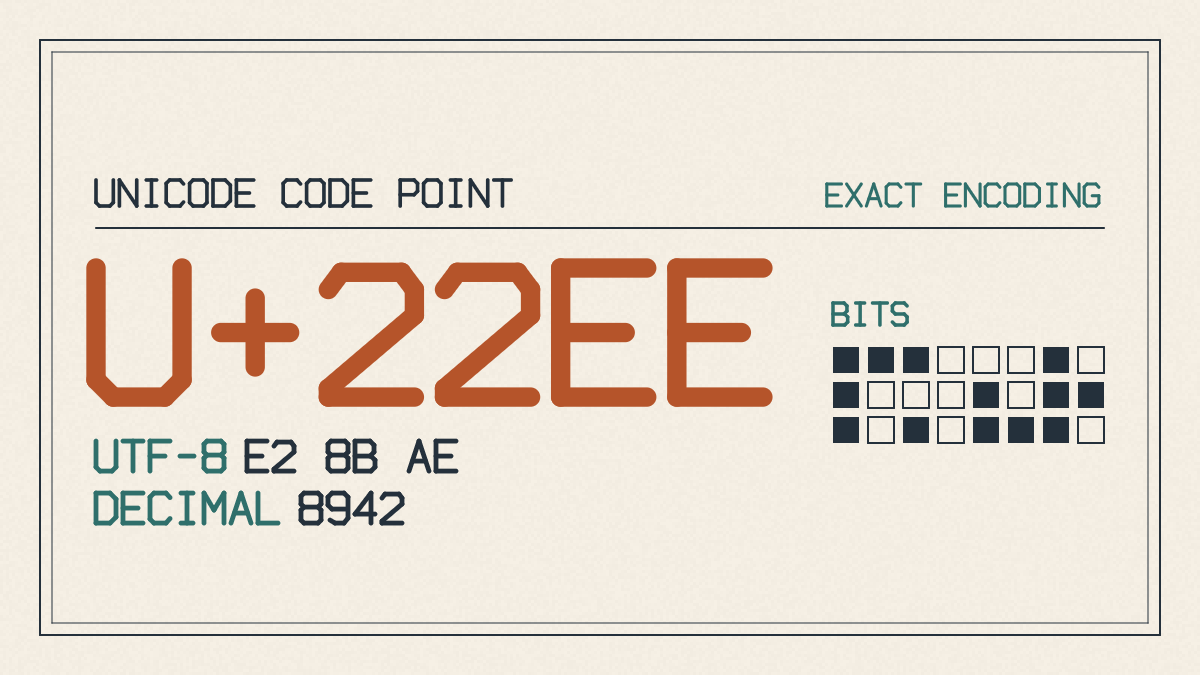
This article gives you all the information you need to use it.
The vertical ellipsis, represented by the glyph ⋮, is one of Unicode’s many mathematical symbols. As with other symbols, however, it has its own history in terms of both usage and Unicode identity.
Unicode identifies this as “Vertical Ellipsis,” with the code point U+22EE. It is part of the Mathematical Operators block, which ranges from U+2200 through U+22FF. The vertical ellipsis appears on the Basic Multilingual Plane, which is defined as U+0000–U+FFFF. The script associated with the symbol is Zyyy, or Other.
According to Unicode Version 1.1, released June 1993, this glyph was introduced as “Vertical Ellipsis.”
You’ll see how you can reproduce this glyph in different applications and contexts below.
How to copy and paste the vertical ellipsis
On your Windows keyboard, hold down the Alt key and type the number 8942 using the numeric keypad.
To enter the character directly into documents, try these approaches:
Decimal: 8942
Windows: Num Lock + numeric keypad + Alt+8942
HTML decimal: ⋮
HTML hex: ⋮
HTML named entity: ⋮
CSS: \22ee
Unicode: U+22EE
What does the vertical ellipsis mean?
In mathematics, the ellipsis represents an omission within a sequence of characters. This can be in either the horizontal direction (an ellipsis such as “…” indicating that there are more elements) or vertically (a vertical ellipsis). In a matrix context, for example, a vertical ellipsis can represent rows being left out.
In a general sense, though, the vertical ellipsis is three vertically aligned dots representing a list that extends vertically. However, there’s also a divisibility interpretation of the vertical ellipsis.
There are other ways that you can interpret an ellipsis — like indicating that something is missing, but the vertical ellipsis may have another meaning altogether depending upon the context.
If you’ve ever looked at an equation written in TeX, you’ll notice that it uses the command \vdots (which stands for “vertical dots”) to insert a vertical ellipsis.
Other vertical ellipses
There are other variations on the ellipsis shape. Here’s how they differ:
⋮ Vertical Ellipsis
⋯ Midline Horizontal Ellipsis
⋰ Up Right Diagonal Ellipsis
⋱ Down Right Diagonal Ellipsis
Each pattern provides different clues about the structure within the equation, especially in matrices. The midline ellipsis, for instance, can abbreviate matrix elements, whereas a down-right diagonal ellipsis can indicate elements that follow a pattern.
Can I use the vertical ellipsis in my interface?
Technically, the vertical ellipsis isn’t really meant to convey an overflow or menu affordance. Rather, the vertical ellipsis simply represents a vertical continuation, as noted above.
That said, the vertical ellipsis might appear visually similar to an overflow affordance. You might want to avoid relying on this alone, however, because the Unicode version of the vertical ellipsis remains a math symbol (Sm), and not an ARIA role.
In short, the appearance is important, but only if the control is properly labeled. For example, if you wanted to provide users an option to sort a table of data, you would use the appropriate controls rather than just adding an ellipsis. You’d then label it appropriately. In effect, the semantics of the control are where the real importance lies.
Final thoughts
Use the vertical ellipsis when a vertical sequence continues or when the notation means that a value is divisible by another value.
Otherwise, use the appropriate ellipsis codepoint for your needs, depending on orientation. And when you borrow the shape for UI work, remember to implement it properly with accessible semantics.
A final word
For our purposes, the vertical ellipsis (U+22EE) simply continues a sequence vertically.