Copy the Colon Symbol : and Understand Its Uses
Copy the colon symbol : (U+003A), understand its uses in English text and math, and distinguish it from ∶, ⁚, and :.
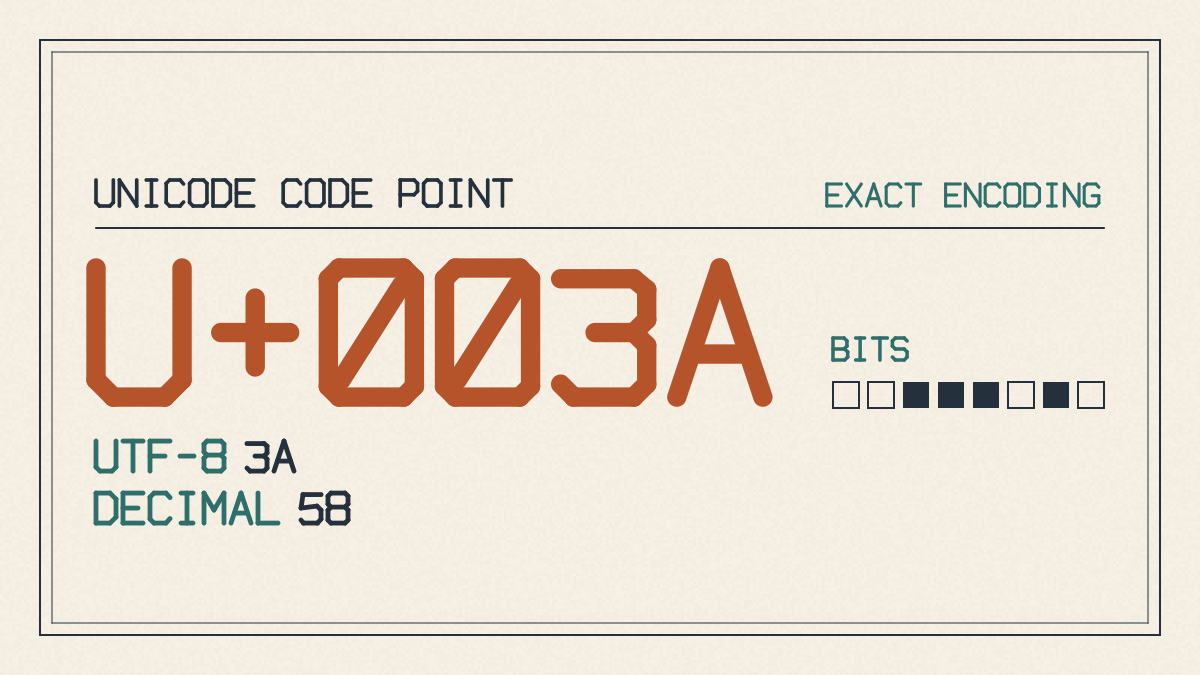
If you’re trying to copy the colon symbol, you may need to know that it’s simply the colon. The Unicode identity of this character is U+003A COLON. As a decimal ASCII value, it’s 58.
The HTML named reference for the colon is :.
How do we use the colon?
We can introduce a list, an appositive, a quotation, or even an explanation after an independent clause. A second independent clause might summarize or explain what was in the first independent clause. (Note: In modern English prose, no space is placed before the colon, though one space is usually placed after.)
In time notation, the colon separates numbers indicating hours, minutes, or seconds. In ratio notation, it separates the quantities being compared. The difference here is that these are two distinct contexts with different spacing needs. That is, they are separated by the colon. One context uses the ordinary English prose spacing rules, while the other uses the spacing rules specific to time and ratio notation.
Time
In some time notations, such as the hour–minute relationship, the colon separates units. You’ll see something like 3:00 PM where 3 indicates the hour and 00 the minutes. This also extends to seconds, which would be expressed as hours:minutes; minutes:seconds; or hours:minutes:seconds.
Ratio
Ratios often use colons, but they might mean slightly different things depending on the mathematical context. For example, if you write “2:1,” this might be referring to a ratio of 2 to 1, or odds of two to one.
Set Notation
You might have also seen the colon used within set notation. If you have the expression {x|y}, the vertical bar means “such that.” So the x is the variable, y is the condition, and “such that” introduces the conditional. A colon can also mean “such that,” as in {x:y}.
What about other characters that look similar to the colon?
Ordinary Colons
There’s another colon character that looks similar to the ordinary colon, although it has a dedicated role in mathematics: the ratio character, which is represented as ∶, or U+2236 RATIO. Otherwise, the fullwidth colon is used for compatibility purposes, ensuring that when the font supports both halfwidth and fullwidth versions, the correct character will appear.
In general, selecting the appropriate colon character depends upon the character’s identity and intended use. For instance, the ordinary-colon is used for ratios in the same way that the colon is otherwise used.
Colon vs. Semicolon
Colons and semicolons perform similar tasks in writing, but their roles are quite different. A colon is typically used to introduce a list, explanation, or definition. In contrast, a semicolon connects two closely related complete sentences. Additionally, the semicolon can be used to separate items within a list that contain commas themselves. Choosing between a colon and semicolon depends on your intended relationship between clauses.